


Colorado Attorney General Phil Weiser fielded questions on Wednesday from residents of Costilla County who are becoming increasingly frustrated and concerned with billionaire Cielo Vista Ranch owner William Harrison’s approach to the construction of an eight-foot tall high fence around the property.
The La Sierra Environmental Guardians Committee, which is made up of San Luis and nearby village residents, said that Weiser is the first and only state public official to show real concern and take the time to see the fence for himself. In February, the council pleaded for state-wide help from every facet they could, including the governor, state senators and representatives, health departments, the division of wildlife, and the attorney general’s office.

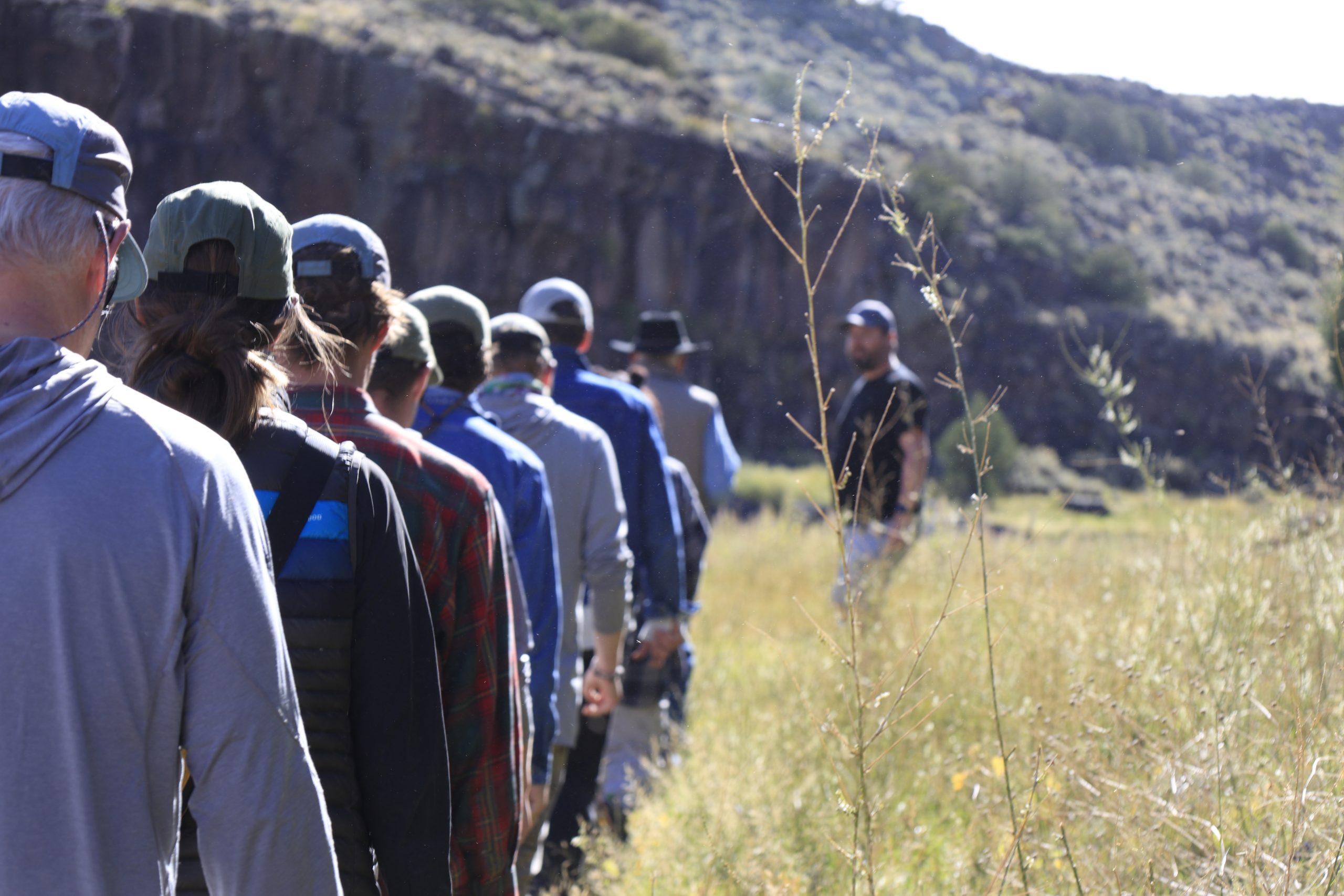
Before he spoke to a crowd of 100 or so people at Centennial High School Wednesday afternoon, members of the guardians committee took Weiser and his staff on a tour of the land that is marked and scarred by the fence and the tools of construction.
“When issues come up all across the state that may not fit neatly into what people thought the attorney general does, but are of grave concern to communities, my job is to make sure I can show up,” Weiser told the crowd. “I can understand what people are concerned about and ask how we can work together to address a concern.”
Disrupted migration paths of elk and deer, damage to the watershed, runoff and sediment pollution, and the actual size of the fence are the key issues that have disturbed the residents. A short video was presented showing a herd of elk completely halted by the fence, forcing them to turn back.
One video showed a wild turkey walking back and forth along the fence, unable to cross. The fence is just over eight feet tall with a line of barbed wire along the very top. However, what is most concerning is the design of the grid. The grid tapers down to the ground with spaces that are less than three inches wide, allowing only small animals to pass through.
There are deer jumps along the fence, but have no rhyme or reason behind placement and spacing. The ranch said the jumps were placed based on the workers’ observations of animal movements. Colorado Parks and Wildlife guidelines for fence construction and deer jump placement have been disregarded by the ranch.
Colorado Parks and Wildlife Area Manager Rick Basagoitia told The Citizen that the agency has no jurisdiction over the fence, despite concerns about migration paths and how that may affect wildlife. Because the ranch is private property, CPW doesn’t “really have a right to have a problem with it or not.”
Residents also raised more personal concerns. Many have historic access to the Cielo Vista Ranch granted to them through the Sangre de Cristo Land Grant. They say the fence will impact their right to access the mountain for the purposes of grazing their livestock, collecting firewood, and fishing and hunting.

Jerome Herrera, a lawyer who has worked pro bono on the Lobato v. Taylor case for the past 20 years, told residents that access rights are still being upheld. He encouraged those who have access rights to the land to continue to exercise them.
Many raised the issue of an out-of-town billionaire who is seemingly ignoring the worries of the community. Despite this, Joseph Quintana, a member of the guardians committee, said that one of Harrison’s attorneys, Jamie Cotter, has indicated that there is room for cooperation.
One of the largest and most pertinent issues the community has is Harrison’s ability to pay for a legal staff, while the residents of Costilla County are represented through a single county attorney and the work of pro bono attorneys.
“What can we do, given the owner of the ranch has so much money?” Weiser asked rhetorically. “In America, it doesn’t matter how much money you have, the rule of law and the protection of people come first. Our government and our Declaration of Independence is premised on this idea.”
Weiser noted that he has been taking on Google, Facebook (Meta), and the Kroger-Albertson’s merger – the largest grocery store merger in U.S. history. These are all big corporations that have hundreds of lawyers and hundreds of billions of dollars at their disposal.
“For me,” he said, “it doesn’t matter how much money someone has, it matters [if], is the law being followed, are people being protected? And when people or natural resources are being hurt and communities are feeling harms, my job is to defend those communities.”
Will the ranch owner be willing to compromise? That’s a question that everyone has been asking since Harrison purchased the 80,000 acre ranch (and 14,000-ft Culebra Peak) in 2017. “It’s a concern,” Weiser said, “because the residents are seeing that…. If there’s not a collaborative solution, that’s where the legal system comes in.”
In 2021, Judge Kenneth Plotz found that the Cielo Vista Ranch staff and managers treated the land’s access holders as “second-class citizens” and saw a clear imbalance of power through means of harassment, intimidation, and unwarranted surveillance. Many residents allege that harassment and intimidation from the ranch manager Carlos DeLeon and his staff continue to this day.
One resident said she was given a trespass warning for exercising her rights on the land.
DeLeon insists that the purpose of the fence is to keep out trespassers who illegally access the land to hunt, fish, and gather firewood they don’t have rights to. DeLeon told the court in 2023 that the main reason for constructing the fence, along the majority of the boundary, is to keep Harrison’s herd of 60 buffalo safely within the ranch.
Members of the La Sierra Environmental Guardians Committee have been skeptical of this reasoning.
In October 2023, the ranch was ordered to stop construction of the fence through a moratorium and a signed agreement between Costilla County and Cielo Vista Ranch.
The moratorium was ignored by the ranch, so 12th Judicial District court judge Crista Newmyer-Olsen ordered Harrison and the ranch to halt construction immediately through a county-requested injunction. The injunction is set to expire in September.
A trial is on the court docket for October. A status conference in August could allow the ranch and Costilla county to reach an agreement that will avoid a trial. District judge Kimberly Cortez will oversee the status conference and trial.


No construction has taken place since the order was issued, but residents still see large construction equipment coming and going. From what they have observed so far, the construction equipment and crews are working on remediation of the steep section of hills that have had 20-foot or wider paths carved into the pinons and hillsides. One section that The Citizen observed in March was full of ruts and showed signs of runoff. Now, that same section is shored up on either side and has a base of hay covering the erosion.
The Colorado Department of Public Health and Environment said in March that because of the apparent damage to the watershed and degradation of the land caused by erosion, it is actively investigating the matter and whether or not the ranch filed proper permits. Photographs taken by Alamosa Citizen were provided to CDPHE for reference.
John Michael, CDPHE’s marketing and communication specialist, said in a Thursday email that the department’s Water Quality Control Division conducted an on-site inspection of the fence on June 10 and 11.
“During the inspection,” Michael wrote, “the inspectors observed disturbed areas, including steep slopes, without control measures to prevent erosion sediment discharges from the construction activity.”
The water quality division issued a preliminary inspection report to the Cielo Vista Ranch on June 17. He said that a final report with a compliance determination will be issued at the end of July. Alamosa Citizen will request a copy of that report once it is released.
“The inspection reports spell out that the operators of Cielo Vista Ranch must address the issues we found on the inspection.”
The ranch will then have the opportunity to respond and “the division expects Cielo Vista to make the corrections. Based on site conditions observed during the June inspection, the division plans to conduct a follow-up inspection in accordance with our typical practice.”
Weiser stood at the front of the room and listened to emotional testimony and personal accounts of how this fence has impacted daily life. For the most part, questions were few and far between. What emerged was a multitude of personal concerns from people who are seeking answers, guidance, and help.
In America, it doesn’t matter how much money you have, the rule of law and the protection of people come first.
Phil weiser
Even a day later, the magnitude of the meeting was something Weiser was still wrapping his head around. During an interview on The Valley Pod on Thursday, Alamosa Citizen asked Weiser what he took away from the meeting.
“The point that I continue to pay attention to, over 70 people showed up in the middle of a work day in a county that has 1,000 people. That’s an extraordinary statement in and of itself.”
One issue raised at this meeting that had not been publicly addressed in-depth before was the impact the situation is having on the mental health of the community. A resident spoke about how the issue has affected the Moradas and the ability for the Penitentes to practice.
It has disrupted daily life for some.
“Points were made about this fence in terms of its impact on spiritual and religious practice, access to a cemetery, the message that this fence is sending to community members, the impacts its having on wildlife, on water, on access to firewood.”
Weiser noticed that this fight is generational and is far from new.
“The message that I want to leave the community with is my commitment to be there to listen, to work with them, and to be a public servant for them…. They had real concerns whether the state of Colorado has their back, is listening, is engaged and my takeaway is it’s really important that I show up to listen, that I be a trusted partner with the county and the community and we’re committed to that.”
Weiser said he always leaves the San Luis Valley with more passion.
“I believe this Valley has that collaborative spirit where people see themselves as part of a broader whole,” he said.

Shirley Romero-Otero, who has been fighting for access rights and on behalf of the people of Costilla County for decades, gave an impassioned plea at the end of Wednesday’s meeting: “We do not want to negotiate from the bench…. We are fortunate that we have pro bono attorneys. And to all of you who think that the attorneys haven’t done enough, then you get involved and do some of the work.”
She continued, “All we want to do, since 2002 when we got that decision, is to be able to enjoy the rights that we have fought for so long, since 1960 when our grandparents and parents were involved. That’s all we ask. He is not a good neighbor, but he needs to understand we are not giving up on this fight, we are going to continue to struggle as long as we can move and think, but we ask of you that any illegalities that have been committed since two, three years ago that he started that he pay for not having permits, for the damage to our watershed, to the lifeblood of this community.”